Twitter Election Campaigns Go Hyper Local

Twitter stole a march on social media rivals when it announced yesterday that ads and promoted tweets will be able to be geo-targeted down to individual postcodes for the first time.  Facebook can target towns and cities but not streets or significantly in the run up to the election, individual constituencies.

For political parties fighting at constituency level, where the race to win a seat is likely to be close, targeting by postcode could prove to be a powerful weapon in the digital armoury.

Postcode targeting gives candidates an opportunity to push policy on local issues or raise the profile of a candidate fighting for a seat for the first time.

The ability to target audiences at hyper local level is added to existing options that include interest, gender and keyword targeting.

In an election that will be fought hard with more battleground constituencies than ever before this could give candidates with skilled digital advisors a real advantage.
One Hundred Days to Go

We the enter final 100 days in the run up to the 2015 UK general election.  It will be unlike any other election in history, not least because we know that it will be on May 7.

For over a 100 years we’ve had a maximum term of five years but few parliaments actually lasted that long. Before the current coalition government introduced the Fixed Term Parliament Act an election could be called with as little as 17 working days notice following the dissolution of the Parliament by the Queen. A typical election campaign lasted just a month and usually the incumbent Prime Minister chooses to call a general election at a time when they believed they have a lead in the polls or a comparative  advantage.

It will also be the most complex and unpredictable election in modern history. The combined Tory and Labout vote is lower than it has been since 1922 the first election in the UK and Norther Ireland (after the Irish Republic came into being).

With the Green Party, UKIP and the SNP all gaining increased support the next 100 days will see an election campaign like no other.


New Ballot Blogs Site

With just over 100 days to go before the UK 2015 general election on May 15 the ‘Politics10’ blog that was created for the 2010 election has been completely revamped and relaunched today with a new name Ballot Blogs.

There will be regular posts in the run up to the election covering every aspect of the campaign and taking a particular interest in what’s going on online and in social media.

You can book mark the page, follow on Twitter or sign up using the subscription box on the right.

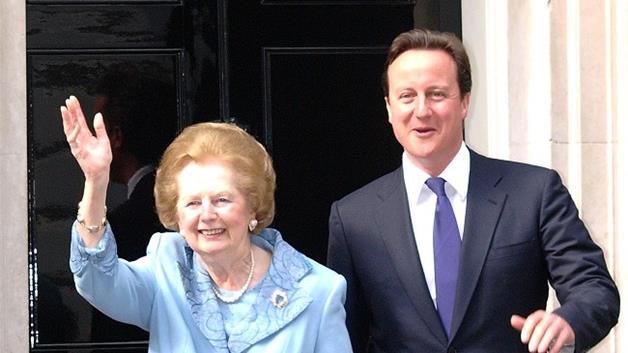
Cameron Backs Thatcher Museum as Northern Museums Face Axe

David Cameron is giving his public backing to a £15 million Thatcher Museum at the same time as  The Museum of Science and Industry in Manchester, National Rail Museum in York and Bradford’s National Media Museum face the threat of closure as a result of Treasury cuts.

The Prime Minister wants a museum modelled on the Ronald Reagan Presidential Library and Museum in California.  The memorial to Margaret Thatcher is likely to include a selection of her suits and handbags.  The announcement comes just a few weeks after the controversy over the multi-million pound tax-payer bill for Lady Thatcher’s funeral.

Meanwhile  the Science Museums Group which comprises the the three Northern Museums will see a £6 million cut in its budget in George Osborne’s spending review later this month.   The severity of the cuts may lead to the closure of one or more of the museums.

Thatcher ‘s policies greatly amplified the so-called North South divide and Cameron risks further losing popularity North of Watford with the insensitive timing of his backing for a Thatcher Museum.  The northerm museum cuts have already caused outrage with a huge on-line campaign and over 20,000 people signing a petition in 24 hours.

Withington MP John Leech, the Liberal Democrat culture spokesman has condemned the cuts and praised the Manchester Museum of Science and Industry: “It is part of our fabric here in Manchester, it inspires the hundreds of thousands who walk through its doors every year.  I’ve raised this in Parliament as it’s vital we retain this fantastic museum for future generations.”

Hacking scandal beats a path to Cameron’s Door

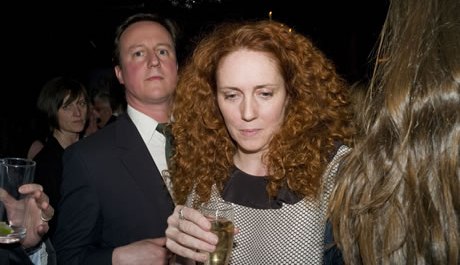
david cameron and rebekah brooks

Many political aficionados were beyond surprised when David Cameron appointed the former News International apparatchik Andy Coulson, to manage his communications.  Coulson was already tarred in the hacking debacle but Cameron felt he should have a “second chance”.

That decision was either a cold, calculated gamble to garner the powerful endorsement of the Murdoch empire in the run up to a general election or it was spectacularly naive.    Either way it has backfired on the prime minister.  Twitter is alive with condemnation and News International are hanging Coulson out to dry with the revelations that he authorised payments to the police.  Is this a shot across Cameron’s bows by Rebekah Brooks?

A full public enquiry will undoubtedly turn the spotlight on Cameron and how much he knew or should have know about Coulson’s activities.   It will also be very uncomfortable for a number of high-ranking members of the metropolitan police.

This has implications too for the coalition.   It provides a once in a parliament opportunity for Nick Clegg to revive the fortunes of the Liberal party on an issue that isn’t part of the coalition agreement.

The Devil and the Deep Blue Sea; Which Way Now for the LibDems?

The Liberal Democrat vote is tumbling, with no prospect of let up.  The party and its leader Nick Clegg are bearing the brunt of the criticism of coalition policies with the Tories taking far less of the flack.  A referendum is due in May and there is the very real prospect that the unpopularity of  the LibDems will see the opportunity for electoral reform vanish for a generation.  I spoke at length with a senior member of the parliamentary party yesterday and there is a real fear that this might happen.

So what can they do?  If they were to leave the coalition there would be a snap general election.  The LibDem vote could be halved and a majority Tory government would abandon AV.  If they carry on with the status quo the rifts in the party will grow and support will continue to fall.  The mantra from the parliamentary party is “wait and see, this is a five year parliament”.  That is a strategy of hope and hope is no strategy.

There is one route open.  The LibDems agreed to be part of a coalition government and to support a programme of legislation.  They however made no promise to remain uncritical.  Were there never any dissenting voices within the last Labour government?  Didn’t Claire Short call Tony Blair pompous and was she not branded irresponsible in return? Brown and Blair both remained in office whilst waging a cold war over the keys to Number 10.  The LibDems in contrast seem to be afraid to voice any criticism lest they should be blamed for a collapse of the coalition.

There need to be a robust defence of LibDem principles.  There needs to be visible, brave and principled debate in place of what looks to some like gutless complicity.   Where there is clear contravention of election pledges the party must learn to say no.   Bad legislation that has been improved at the margins is still bad legislation.  The party may be in government but it has all but lost its voice.

Posts about elections and politics in general with a particular interest in how social media impacts on the political process.