All posts by Editor

ITV Calls Copyright Foul on Election TV Debate Twitter Cock Up

ITV_news

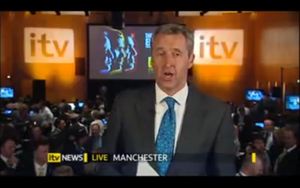
A video clip from last night’s election debate was blocked on YouTube today on the basis of copyright infringement.  Yes in case you were wondering this is the same ITV that used YouTube to pump out clips of Susan Boyle driving millions of viewers to their Saturday night ratings grabber ‘Britain’s Got Talent’. No copyright problems for that show.

So what was the real reason for the cease and delete order to our favourite clips network? ITV discovered what Skittles or the organisers of any social media conference could have told them.  Using an unmoderated live twitter feed is asking for trouble.
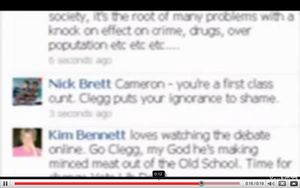
Cameron Debate tweetNick Brett or @MullerNick as he is better known normally has an audience of 32 Followers but ITV handed him another 9 and a half million when they showed his first class commentary on Cameron’s TV debate performance.

The social media pundits, Election10 included, all said twitter would play an important role in the televised debate.  They weren’t wrong.

Sarah Brown Is Going To Keep On Tweeting To Election Day


Back in February we speculated as to whether Sarah Brown’s twitter account might form part of Labour’s social media election strategy.  It is difficult to see how it can play a major part but it will continue help to soften Gordon’s image and it is likely add significantly to its 1.1 million followers in the next four weeks.

There is no doubt that this is Sarah’s account but it does show significant signs of being ‘managed’.   Her follower numbers have been in steady decline this year – possibly bots being removed – but went into increase yesterday on the eve of the election call.

Either way,  if you check the video above Sarah has made it clear she’s going to keep on tweeting.

Will Social Media Be Decisive in the May 6th Election?

Now the campaign proper is in full effect and the media beast needs feeding on an hourly basis, one of the big questions on the lips of journalists is “will Facebook and twitter change the course of the election?”.  The answer is of course “yes and no”.

Social media will have less impact in the UK in 2010 than in the US in 2008 for a number of reasons:

  • Social networks are not as instant as people believe  they take time to build.  In the US fixed term system this meant they could start more than a year in advance.  We have four weeks.
  • We vote for local MPs.  We don’t vote for a president (or even a prime minister).  Social groups coalesce better around iconic individuals.
  • We have national ‘mainstream media’ in a way that the US does not.
  • The US is bigger, with different time zones so ‘opt in’ media that isn’t constrained by time or schedules works better.

In addition there is no party or individual that has achieved a huge level of traction in any of the social networks, with the exception of Sarah Brown who isn’t a politician. In the “yes” camp there are some persuasive arguments:

  • The verdict on the all important TV debates will be on-line and will be democratic.  We saw this in the Ask The Chancellor debates on Channel 4.
  • In a real sense people will participate in the debate and if an issue trends the politicians will have to answer.
  • Social media means that the media is ‘always on’, far more so than 24 hour TV news.  Any banana skins and we’ll know as soon as the politicians do.

Gordon Brown •••••••• Calling the General Election Tomorrow

It’s still the view at Election 10 that the vote will be on May 6th but the idea that Brown will go to the Palace tomorrow to seek a dissolution is frankly a load of toss. Why? Because he doesn’t have to.

The last date for calling an election to be held on the 6th of May is next Monday (12th April) and that is when it will most likely happen.  Any sooner and that will mean that the phony war is over and the campaign will be stepped up several gears. The shorter the campaign the better as far as GB and the Labour Party are concerned.   The Tory party coffers are much deeper than Labour’s and that means more money for campaigning and costly advertising.  Calling the election tomorrow will put the socialist fighting fund at risk of running out before the plebiscite. That, quite simply, is why it won’t happen.

Note: this article made a bold and perhaps with the benefit of hindsight foolhardy claim about the date the election would/would not be called. It was amended late on Monday 5th April but the original is intact as you can see for your (and our) amusement. 

Channel Four Debate ‘Ask the Chancellors’ – TV and the Back Channel


Tonight’s televised debate between the leading candidates to be the next Chancellor of the Exchequer will provide a solid indication of the potential relevance of social media in the coming election.   Whilst the arguments are played out in the front channel (the TV), the arguments and analysis will be broadcast simultaneously in what has become known as the back channel.  Specifically social media and in particular, twitter.  The programme makers are promoting this and have created a hashtag #askthechancellors, so that two-screen viewers can follow the debate – front and back.  Live online reaction will also be played back to the TV audience.

The on-line debate will alow anyone to voice an opinion with the potential for that opinion to be propelled either by other like-minded voices on-line or through broadcast TV.  There will also be the coordinated voices of campaigners like the InVinceCable, the social media pressure group who launched their campaign to back Vince Cable earlier today.

Before the credits roll we will have a clear sense through the on-line commentary of which of the pretenders to Number 11 Downing Street has caught the mood of the nation.  This is important partly because it paves the way for what will happen in the party leader debates but also because it is our economy that is at stake.

David Cameron’s “Too Many Twits Make a Twat” Was a Major Boob

When David Cameron met Christian O’Connell on Absolute Radio and uttered the now infamous comment when O’Connell asked him why he didn’t use Twitter, he boobed big time.  The Tory leader’s utterance “The trouble with Twitter… too many twits might make a twat.” may prove to be a far bigger faux pas than originally thought and for quite different reasons.

By branding users of the social network as twats he effectively curbed his party’s ability to make the most of the social network.  In short if you are a Tory MP on twitter the leader thinks you might be a bit of a twat.   The ‘twat effect’ is now becoming evident as Tory MPs fall behind on the network that was one of the social media pillars of the Obama campaign.  Tweetminster delivered a breakdown of MPs (and MEPs) today that put the Tories 5 points behind Labour.  

The party breakdown of politicians (MPs + PPCs) on Twitter was as follows:

  • Labour 34%
  • Conservative 29%
  • Liberal Democrat  24%
  • Others 13%

If you look at the latest share of tweets the Tory party is in third place with just 18% behind Labour and the Liberal Democrats. This election wont be won or lost on twitter by any stretch of the imagination but is does seem a little naive to immobilize a key platform just to get down with the kids.

From Cash Gordon to Crash Gordon – Hack Brings Down Tory Site

On Saturday the Tory Party launched a web assault on Gordon Brown with a site called Cash Gordon.  The site highlighted Brown’s links to the Unite union and invited users to play to earn ‘action points’ by tweeting about the campaign.   When the lobby for cash story broke Cash Gordon started to gain significant interest.

However things started to go wrong on Monday morning when users realised that the site was posting unmoderated tweets with the #cashgordon hashtag.  You can imagine what started to happen with the tweets.   Things then got much worse for the young turks running the Tory web campaign.  Users discovered a security flaw which allowed the site to be hacked multiple times during the early afternoon of Monday.  Twitter users were circulating the  JavaScript code online and the URL was directed at a multitude of locations including the Labour home page and several somewhat more salacious sites. 

At the time of writing Cash Gordon is no more and the URL is directed at the news pages of the main Conservative site.

Facebook Ramps Up Interest in Election with Democracy UK

Facebook has pitched into the election space with Democracy UK,  a campaign page that will carry information from the political parties in the run-up to the vote.  The sister of Mark Zuckerberg, Facebook’s director of market development, Randi Zuckerberg (above) is overseeing the launch.  The political parties are also starting to target Facebook with ad campaigns.

Facebook was a pivotal space in the run up to the last US presidential election but so far it hasn’t gained the same traction in the UK – partly because our elections are less focussed on individuals and more on parties.  The US primaries also mean that the process is ‘live’ for several months.  When the UK election is called there will be less than four weeks for the campaign to run.  Whilst many regard social media as instant the truth is that it takes months for the bandwagon to roll on sites like twitter and Facebook.     

Democracy UK is and attempt to garner interest amongst the UK’s 24 million Facebook users but its a tough challenge – the page has less than 100 fans at lunchtime on launch day and it is heavy in information and light on applications.

Conservatives Take Campaign in Marginals On Line and Hyper Local

Much has been made of the Tories’ foray into the web on a national stage. There’s an in-depth feature about the party’s on-line strategy in this month’s edition of Wired – print version only so rush out and buy.

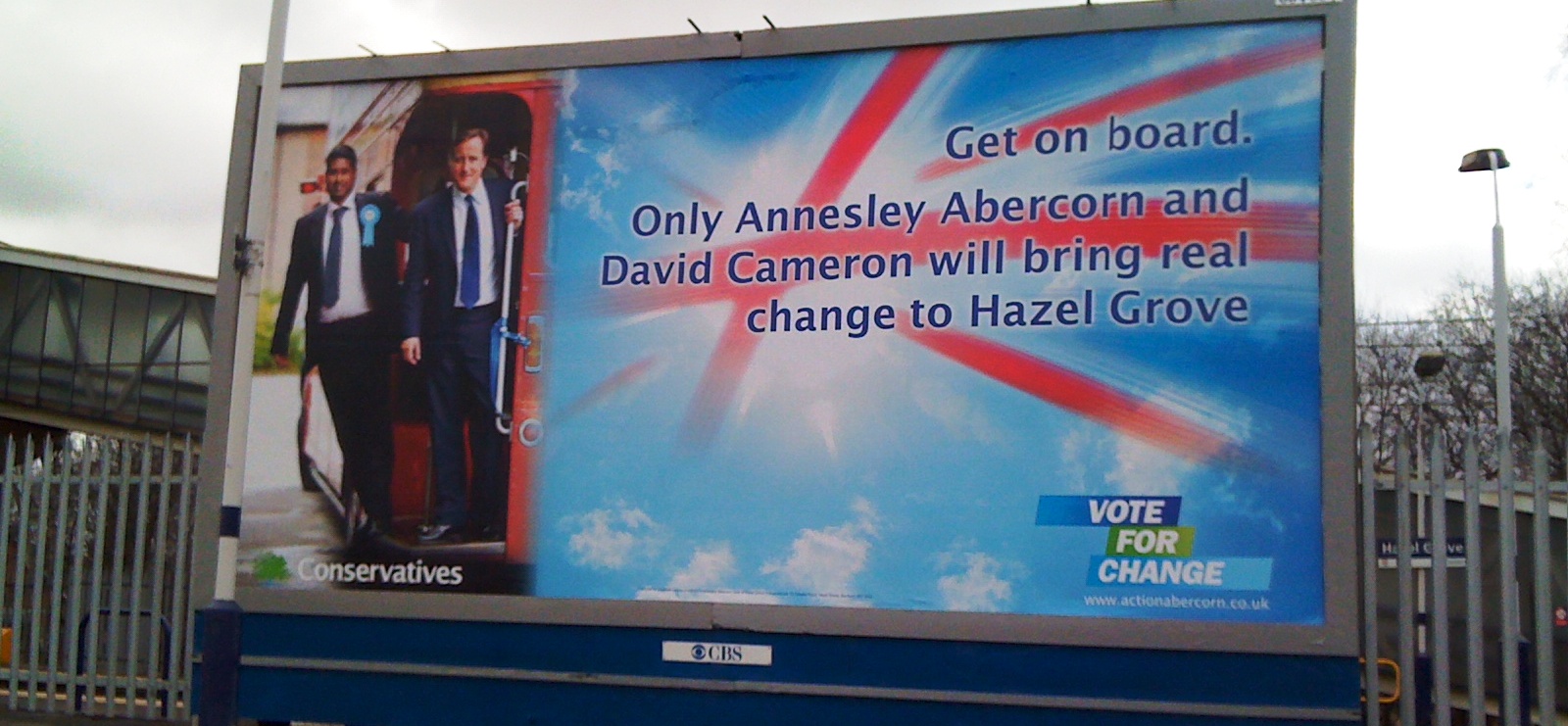
The Conservative Party is clearly also taking the fight to the doorstep.   Marginal seats are where the election is lost and won.  This poster site was snapped at Hazel Grove station at the weekend. Hazel Grove and Cheadle, the constituency immediately adjacent are both marginals.  On the bottom left there’s a URL for http://www.annesleyabercorn.com a site dedicated to Annesley Abercorn the Tory candidate.  This strategy is being replicated across the marginal seats.

A quick look at the site and you can see that it’s rich in social media content.  Centre stage is a YouTube clip featuring a constituency pub, a local pie-shop and a quick interview with the Coronation Street stalwart Bill Roache (Ken Barlow to you).   There are interviews with local people and a clip with the party leader sounding as if he actually know a bit about the place.  There’s also a link to a Facebook page.

Slightly less compelling given that Annesley is a Londoner is the endorsement from Boris Johnson, oh and the London Bus that they have given him for the campaign.  I guess there’s local and local.

Twitelection – Twit Was Inevitable Really

Twitelection

We suspect this will be one of many ‘tw-opinion’ polls that use twitter to predict how the nation is feeling about the election, how people plan to vote and ultimately the outcome. 

Twitelection invites users not just to name a party but to use  happy or sad face to express sentiment or emotion in relation to the main parties. It also needs the hashtag #ukvote and of course the name of the party.  There is an option to include postcode information that could be used in conjunction with constituency mapping to predict the outcome in marginal constituencies.

Over time it shows how the twelectorate (Ok that’s enough….ed) are feeling about the parties rather than simply how they will vote. Twitelection Voting Rules

At present there aren’t quite the volume of tweets out there to make this a meaningful assessment of real changes attitude to the party but it is early days and as the campaign and the tweets ramp up it could become part of our daily election stat diet.